Prior to World War I and the development and widespread adoption of two-way radio that supported voice, wire telephone spelling alphabets were developed to improve communication on low-quality and long-distance telephone circuits. Bell Systems lead the way.
In June 1915 the world’s first air-to-ground voice transmission took place at Brooklands (England) over about 20miles (ground-to-air was initially by Morse code but it is believed two-way voice communications was achieved by July 1915). In early 1916 the Marconi Company (England) started production of air-to-ground radio transmitters/receivers which were used in the war over France. Military voice radio operators used phonetics unique to their country and often unique to their country and service. (Navy vs Army, etc.)
Throughout World War II, many nations used their own versions of a spelling alphabet. The US adopted the Joint Army/Navy radiotelephony alphabet during 1941 to standardize systems among all branches of its armed forces. The US alphabet became known as Able Baker after the words for A and B.
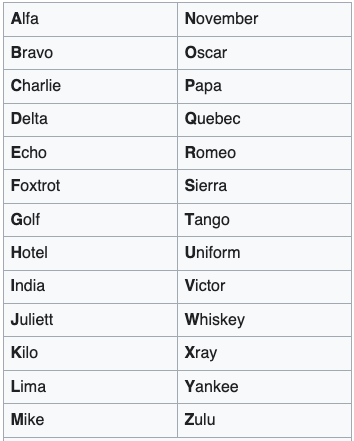
Eventually the UK came along. Because of contention, US and UK Generals took turns choosing words. 13 each. This was the second “Able Baker” version.
After World War II, with many aircraft and ground personnel from the allied armed forces working in commercial aviation, “Able Baker” was officially adopted for use in international aviation during the 1946 Second Session of ICAO. (International Commission for Air Navigation)
The table we use today, the NATO phonetic alphabet, wasn’t put into service until 1956 — after the Korean War.
For an entertaining recounting of the politics and science (that goes into weeds?) Watch the video. 24 min.
 Coos County Radio Club