Digital Mobile Radio – Internet linked Ham Radio.
As club members may be aware, there are no DMR VHF repeaters in the Coos County area. (At least to this editor’s knowledge.) If your HT has DMR mode, that mode is basically useless on the local air unless you have a friend and both radios are programmed correctly to use DMR.
However! DMR is a great way for Technician class operators to make contacts around the world. If you’re curious about DMR, it’s easy to jump in with nothing more than a web browser.
What is DMR? Well, as an amateur radio digital mode, the encoding improves weak signal reception. Also the packets are designed to be sent over IP networks (E.g the internet, VoIP.) On basic VHF/UHF FM radio, communication is “simplex” – one party talks at a time. DMR is duplex – allowing two simultaneous speakers. It’s done with TDM. Time Domain Multiplexing – just like analog telephones or POTs. “Plain old Telephone Service.”
“DMR (Digital Mobile Radio) in ham radio is a digital voice standard, adapted from commercial use, that allows two simultaneous conversations (time slots) on a single frequency, offers clearer audio, extended battery life, text messaging, GPS, and connects repeaters via the internet, providing enhanced features over traditional analog radio, primarily using Tier II for licensed users.” Wikipedia. (More about Tiers follow the link…)
https://en.wikipedia.org/wiki/Digital_mobile_radio
BrandMeister and TGIF DMR are carrier networks (requiring call sign login to chat) are the top DMR services. Users that login with their Call Sign and have registered for a DMR ID at RadioID.net with can converse on the DMR network.
Covering them both is a website where visitors can view the map and listen (only) to talk groups on either system – with out a call sign. See DMRMap.APP
https://dmrmap.app/#tg=3141&network=brandmeister
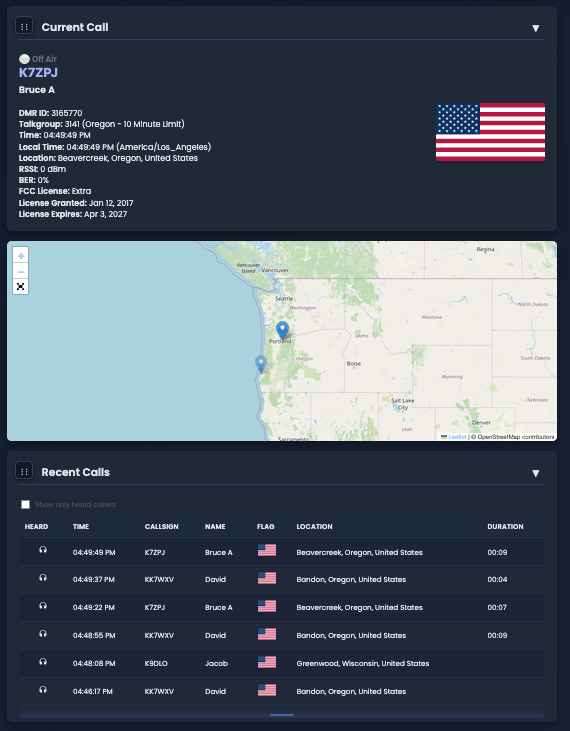
Brandmeister Talk Group 3141 (shown above) links the internet to the West Oregon DMR repeater network. Check out the “Happy Hour” Net at 5PM daily.
DMR is used on the amateur radio VHF and UHF bands, started by DMR-MARC around 2010. The FCC officially approved the use of DMR by amateurs in the US in 2014.
In amateur spaces, Coordinated DMR Identification Numbers are assigned and managed by RadioID Inc. Their coordinated database can be uploaded to DMR radios in order to display the name, call sign, and location of other operators.
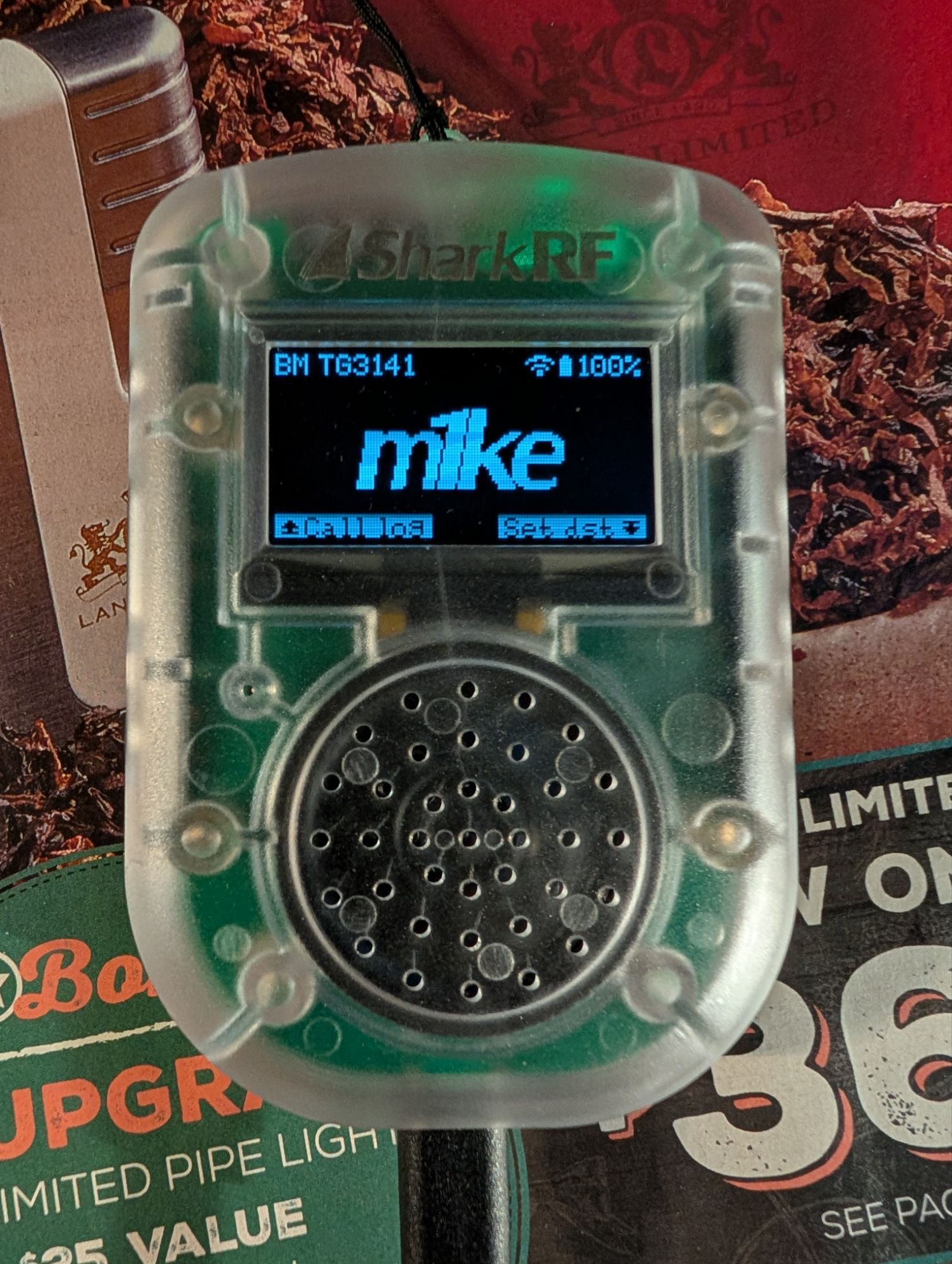
Internet-linked systems allow users to communicate with other users around the world via connected repeaters, or DMR “hotspots.” Such systems are often based on the Raspberry Pi single-board computer.
There are currently more than 5,500 repeaters and 16,000 “hotspots” linked to the BrandMeister system worldwide.
As always! Let us know what you think. Comments and suggestions welcome. More information is available.
DMR Simplex
Yes, amateur radio DMR can operate transceiver to transceiver in a mode called simplex.
Here’s a breakdown:
Simplex Operation: In DMR simplex, two radios communicate directly with each other on the same frequency without the use of a repeater or an internet-connected hot spot. This is also sometimes referred to as “Direct Mode.”
Repeater/Network Operation: This is the most common way amateur DMR is used. A DMR repeater or personal hotspot links users to a wider network (often via the internet, like BrandMeister or Phoenix), allowing for local, regional, or even worldwide communication using Talk Groups. This is a form of duplex operation where the radio transmits on one frequency and receives on another.
Key Points for DMR Simplex:
Settings Required: Unlike simple analog FM simplex, DMR simplex requires both transceivers to have the same frequency, Color Code, and Talk Group ID programmed.
Color Code: A digital equivalent to a CTCSS/PL tone, used for system access.
Talk Group ID: Typically Talk Group 99 is designated for simplex use in amateur radio, though any shared Talk Group ID would technically work if all parties are programmed to it.
Range: As with any simplex mode, the range is limited by terrain, power output, and antenna efficiency—it’s strictly line-of-sight or slightly beyond.
TDMA: Even in simplex, DMR uses its Time-Division Multiple Access (TDMA) structure. On some radios, a transmission in simplex mode may use both time slots, while on others, it might only use one. However, the requirement is that both radios must be programmed to the same time slot (e.g., Slot 1 or Slot 2).
So, while DMR is famous for its wide-area networking through repeaters and hotspots, it absolutely maintains a direct, radio-to-radio simplex capability for local communication.
That is a great question. The DMR radio market is very active, especially for amateur radio operators. The radios available can generally be split into three main categories: Feature-Rich Handhelds (HTs), Budget-Friendly Handhelds, and Mobile Radios.
Here is a list of popular and well-regarded DMR-capable amateur radios across those categories:
📻 Popular Handheld Radios (HTs)
Handhelds are the most common entry point for DMR. They are portable and generally dual-band (VHF/UHF).
| Category | Brand/Model | Key Features/Notes |
|---|---|---|
| Feature-Rich/Best Value | AnyTone AT-D878UVII Plus | Widely considered the most popular DMR handheld. Offers Dual-Band, Dual-Mode (Analog/DMR), built-in GPS, Bluetooth PTT, and supports a massive contact list (up to 500,000). |
| Alinco DJ-MD5XTG | Highly capable DMR HT, often sharing similar internal firmware with Anytone. Available with GPS and APRS support. | |
| Budget/Entry-Level | Radioddity GD-88 | Dual-Band, GPS/APRS, and is well-regarded for its cross-band repeat feature and large contact list capacity. |
| Retevis RT3S / TYT MD-UV380/390 | Very popular and affordable starting radios. They are often recommended for use with the OpenGD77 third-party firmware, which greatly enhances their features and usability for amateur radio. | |
| Baofeng DM-1701 | One of the most budget-friendly DMR radios, also frequently upgraded with the OpenGD77 firmware for better performance. | |
| Commercial Brands | Motorola XPR Series | High-quality commercial radios (e.g., XPR 6550, XPR 7550) that are often available used. Known for superior build quality and audio, but often require commercial programming software (CPS) and may have limitations on channel/contact capacity for ham use. |
| Hytera PD Series | Commercial-grade, known for ruggedness and reliability. |
🚗 Popular Mobile Radios
Mobile radios are typically higher power (20W–50W) and designed for use in vehicles or as base stations.
| Brand/Model | Key Features/Notes |
|---|---|
| AnyTone AT-D578UVIII Plus | Extremely popular Dual-Band/Dual-Mode mobile radio. Features high power (50W), built-in GPS, Bluetooth, and often includes Full Duplex capability (allowing you to talk and listen simultaneously like a phone call on V/U). |
| Radioddity DB25-D | A compact mini mobile radio, Dual-Band, Dual-Mode, with GPS/APRS support. A good option for smaller vehicles. |
| Retevis RT90 | A full-power (50W) dual-band DMR mobile radio with GPS and dual-mode functionality. |
| Motorola XPR 5550e | Premium commercial mobile radio, often used in amateur radio for its quality, though it requires specific programming for ham use. |
What to Consider When Choosing
- Codeplug Complexity: DMR radios require a “Codeplug” (the configuration file) to be programmed with channels, talkgroups, and contacts. Radios like the AnyTone 878UVII Plus are popular because their software is relatively well-documented and widely supported.
- GPS/APRS: Many amateur DMR radios now include built-in GPS to support APRS (Automatic Packet Reporting System) over the digital channel, allowing your location to be tracked.
- Firmware (OpenGD77): For certain budget radios (like TYT/Retevis), installing the OpenGD77 custom firmware is highly recommended by the ham community to unlock a vastly improved user experience and features.
- Analog/DMR (Dual-Mode): All radios listed above support both Analog FM and Digital DMR modes, which is essential for working both legacy FM repeaters and the digital network.
Do you have a specific budget or desired form factor (handheld or mobile) in mind that I could use to narrow down the best recommendation for you?
 Coos County Radio Club