Conditions should improve by late tomorrow.
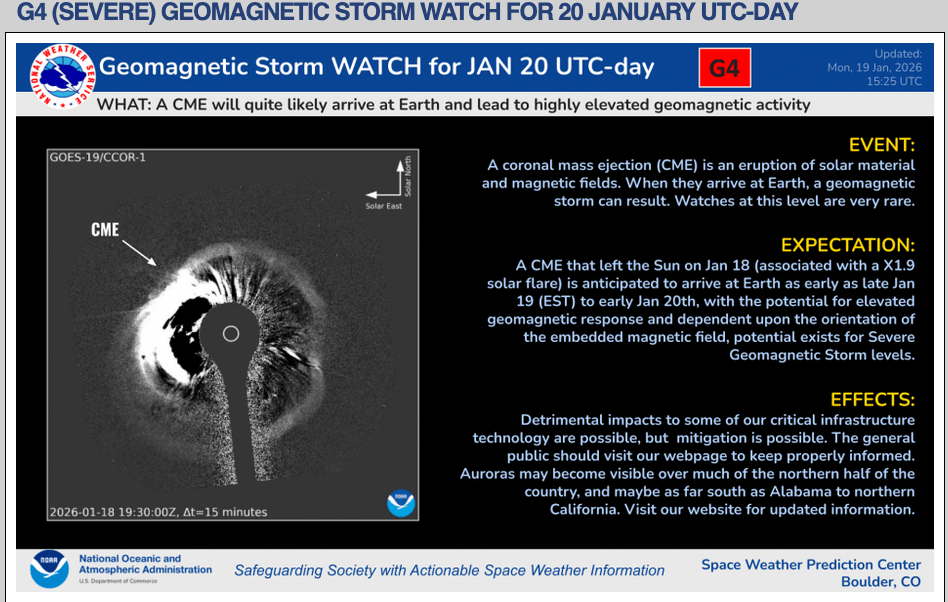
We are experiencing the impact of a major solar event that began on January 19, 2026.
While solar flux is high (generally good for DX), the atmosphere is extremely “noisy” and unstable due to a direct hit from a fast-moving Coronal Mass Ejection (CME).
Impact on Ham Radio Operations
HF Bands (160m – 10m): Poor to Blackout
The G4 Geomagnetic Storm is a problem. When the K-index hits 8, the ionosphere becomes “bruised.”
- Signal Fading: Expect rapid, deep fading (QSB) and a “watery” or fluttery sound on signals.
- Absorption: The D-region of the ionosphere is highly charged, meaning many HF signals are being absorbed rather than refracted back to Earth.
- Polar Paths: If you are trying to work DX over the poles (e.g., North America to Central Asia), expect a total blackout due to the S4 Solar Radiation Storm currently in progress.7
Opportunities
While HF suffers, VHF enthusiasts should stay alert:
- Aurora Propagation: With a G4 storm, the “Auroral Oval” has pushed very far south (into the mid-latitudes of the US and Europe).8
- VHF DX: Operators on 6 meters and 2 meters may be able to bounce signals off the aurora. Point your beams North to look for “auroral buzz” on CW or SSB signals.
Noise Floors
Expect a significantly higher noise floor across all bands. The “static” you hear isn’t just local interference; it’s the Earth’s magnetic field literally ringing from the solar wind impact.
Forecast
The storm is reportedly beginning to subside, but “reverberations” will continue through the day. Conditions should improve significantly by late tomorrow.
 Coos County Radio Club
Thank you! Great info on both the CME and quake. I appreciate the commo. KI7PON Michelle in Bandon!
Be well and happy.
LikeLike
Thanks Michelle!
LikeLike