
“Promising implications for everyday uses in consumer electronics.” Sam Jarman, Phys.org Rydberg-atom sensors become antennas to detect the radio signals, performing demodulation and down conversion automatically. Rydberg receivers could eliminate significant portions of the front-end devices and electronics concerned with signal isolation when compared to conventional receivers. In a Rydberg atom, a single electron isContinue reading “Quantum Antenna?”
Author Archives: CCRC Editor
Club Trailer Discussion
A meeting was held this morning to discuss options for remodeling the Coos County Radio Club trailer. Various ideas were considered, including whether the club should pursue various grant sources to finance some of the work. Ultimately, the group agreed that developing a portable shack for club use would benefit members in a range ofContinue reading “Club Trailer Discussion”
Technicians License Course

A free Technician ham radio class will be held on March 21-22, focusing on the Technician license and essential theory. This educational opportunity aims to provide a comprehensive understanding of the exam and underlying concepts. For more details and registration, contact Scott N7JI at ars.n7ji@gmail.com.
Ionosphere Linked to Earthquakes
Could ionospheric disturbances influence earthquakes? Researchers at Kyoto University explored how disturbances in the ionosphere exert electrostatic forces within Earth’s crust. They found that such forces potentially contribute to the initiation of large earthquakes under specific conditions. The coincidence of strong solar flare activity with the 2024 Noto Peninsula earthquake supports the hypothesis that ionosphericContinue reading “Ionosphere Linked to Earthquakes”
First Gen SigInt Sat Declassified
The NRO has declassified JUMPSEAT, the U.S.’s first-generation signals-collection satellite, which operated from 1971 to 1987. Developed under Project EARPOP, it collected critical electronic emissions and intelligence during the Cold War. The data supported national security agencies, showcasing the NRO’s ongoing commitment to innovation in space for national safety.
WFD ’26 Underway
CCRC Winter Field Day operations are underway at the Powers High School through about 1PM today.
Bruised Ionosphere
Conditions should improve by late tomorrow. We are experiencing the impact of a major solar event that began on January 19, 2026. While solar flux is high (generally good for DX), the atmosphere is extremely “noisy” and unstable due to a direct hit from a fast-moving Coronal Mass Ejection (CME). Impact on Ham Radio OperationsContinue reading “Bruised Ionosphere”
Low Cost Satellite Internet
A Cascadia Earthquake mega disaster will disrupt broad areas of the Oregon coast for weeks at least and perhaps many months. For preparedness purposes, imagine operating from an isolated location with no ISPs or cellular coverage. The solution is satellite connectivity.
Winter Field Day 2026
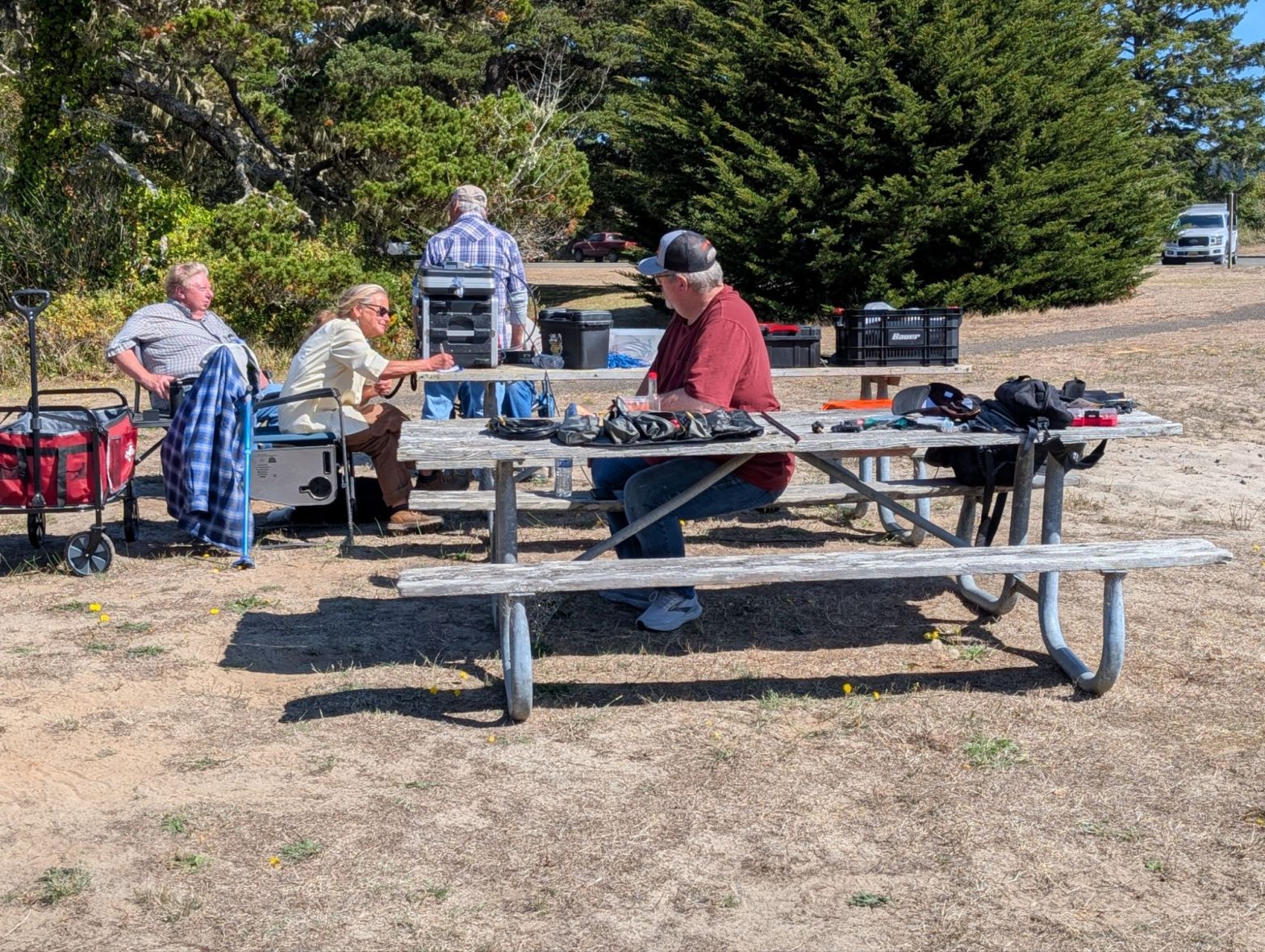
Winter Field Days, scheduled for January 24-25, 2026, at Powers High School Pavilion, aims to enhance portable emergency communications amid winter hazards. Organized by the Coos County Radio Club and Coos County ARES, the event focuses on improving emergency preparedness and radio operation skills under challenging weather conditions. Participants will engage in communication using various amateur radio bands and modes.
Kessler Syndrome
Speculation on the effect of cascading space junk collisions on Amateur Radio. “The Kessler Syndrome is a scenario proposed by NASA scientists Donald J. Kessler and Burton G. Cour-Palais in 1978. It describes a situation in which the density of objects in low Earth orbit (LEO) becomes so high due to space pollution that collisionsContinue reading “Kessler Syndrome”
 Coos County Radio Club