History of Phonetics

Prior to World War I and the development and widespread adoption of two-way radio that supported voice, wire telephone spelling alphabets were developed to improve communication on low-quality and long-distance telephone circuits. Bell Systems lead the way.

In June 1915 the world’s first air-to-ground voice transmission took place at Brooklands (England) over about 20miles (ground-to-air was initially by Morse code but it is believed two-way voice communications was achieved by July 1915). In early 1916 the Marconi Company (England) started production of air-to-ground radio transmitters/receivers which were used in the war over France. Military voice radio operators used phonetics unique to their country and often unique to their country and service. (Navy vs Army, etc.)

Throughout World War II, many nations used their own versions of a spelling alphabet. The US adopted the Joint Army/Navy radiotelephony alphabet during 1941 to standardize systems among all branches of its armed forces. The US alphabet became known as Able Baker after the words for A and B.

Modern NATO Phonetics

Eventually the UK came along. Because of contention, US and UK Generals took turns choosing words. 13 each. This was the second “Able Baker” version.

After World War II, with many aircraft and ground personnel from the allied armed forces working in commercial aviation, “Able Baker” was officially adopted for use in international aviation during the 1946 Second Session of ICAO. (International Commission for Air Navigation)

The table we use today, the NATO phonetic alphabet, wasn’t put into service until 1956 — after the Korean War.

For an entertaining recounting of the politics and science (that goes into weeds?) Watch the video. 24 min.

ARES ICS-402 Training

Saturday October 18, 2025 9:00 am-3:00pm


To participate, register with Kelley Andrews W7FCM (ARES member) at:  

kelleyandrews092@gmail.com

Location:

Coos Bay Fire Department
450 Elrod Ave. Coos Bay
Pizza lunch provided

Or – Online via Zoom, TBA

Instructor:

Chief Rob Aton,
Central Coos Fire and Rescue

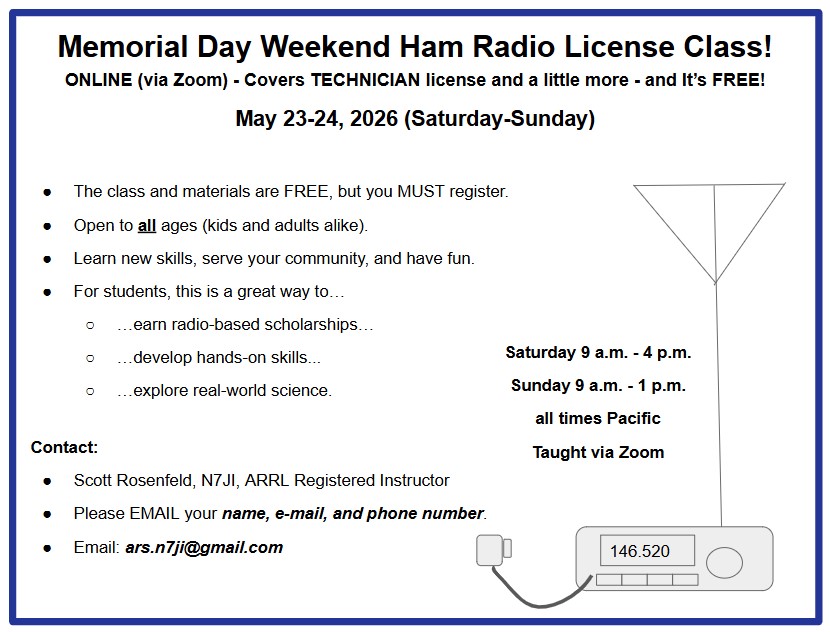
Free General License Class

100% Online via web conference!

Sponsored by the Amateur Radio Club of the National Electronics Museum

Free, weekly, live, Amateur Radio General Class Licensing course via Zoom.

Thursday, October 30 through Thursday, January 8 (9 sessions with no class on Thanksgiving or Christmas).

Sessions are three hours in duration. Class begins at 6:30 PM Eastern Time (3:30 Pacific.)

Participants in the course should have the Amateur Radio Technician license. Or also be studying to take it.

Those wishing to sign up should email roland.anders@comcast.net.

Rol Anders, K3RA

Tom Christovich, K3YH

W7Q – “Shakeout” Call

Special Event Call Sign Application for “W7Q” made by CCRC has been approved for use from 2025-10-15 to 2025-10-19.

Licensed Ham Radio operators – especially those in Western Oregon – are welcome to use the call during the period to make QSO’s of any type. But remember! Transmit only within your license privileges.

This is not a contest. QSO cards are up to the operator. Your logs are your logs, but we’d love to hear how you used the event to spread info on Amateur Radio emergency preparedness.

FCC:

When transmitting in conjunction with an event of special significance, an amateur station (“special event station”) may transmit the identification announcement using a special event call sign in accord with the procedures detailed below. Substituting a special event call sign for its assigned call sign may help a special event station call attention “on-air” to its participation in the special event and to the unique opportunity for the amateur service community to exchange greetings with the station. Use of these provisions, however, must not detract from the station making the source of its transmissions known to those receiving them.

Rules: https://www.arrl.org/special-event-call-signs

W7Q is available for use Wednesday 15th through Sunday the 19th.

Earthquake Exercise

Shakeout Day October 16

https://www.shakeout.org/oregon/

This year’s International ShakeOut Day is October 16, when millions of people worldwide will participate in earthquake drills at work, school, or home!

At 10:16 a.m. (local time) on 10/16, you can join people across Oregon practicing earthquake safety. While we encourage you to participate with everyone, you can register your ShakeOut drill for any day of the year, and drill at a time of your choice. You can also include people in multiple locations through video conferencing.

Spot CQ’s Real Time

New: Real Time, Interactive QSO Manager

From QRZ Labs, QRZ.com is launching RTQM, the Real Time QSO Manager for member accounts.

The public Beta testing phase of the Real-Time QSO Manager, or RTQM begins.

What is RTQM? “Think of it as a spotting network based on real-time user input. It’s a way to call CQ silently, and know exactly when stations are standing by.”

Read the announcement:
https://forums.qrz.com/index.php?threads/qrzs-newest-feature-rtqm.965277/

Pink Ribbon Run & Walk

Pink Ribbon Run & Walk for Cancer

October 4th. 9:00AM.

CCRC & ARES will be providing radio communications. Volunteers needed.

The Pink Ribbon 5K, a fun run to support breast cancer awareness and research.

John Topits Park / Empire Lakes
298-284 Hull Street Coos Bay, OR 97420

For race participants: Tickets at EventBrite.

Antenna Rights

Send an ARRL Letter to Congress.

Support the effort equalize the rights of Ham Radio Operators.

The document (below) supplies a super easy way to send your letters to our Reps:

  • Scroll to the bottom of the document.
  • Scan the QR Code
  • Input your call sign to the form.

The system automatically fills in your details and aligns the message to reach to your legislators.

The ARRL is focused on reducing legal restraints on the ability of American Amateur Radio Operators to engage in the active practice and enjoyment of Amateur Radio.