Clubs across the country will be on the air for the newest operating event of the year — Club Week!
Club Week Nov 1-8
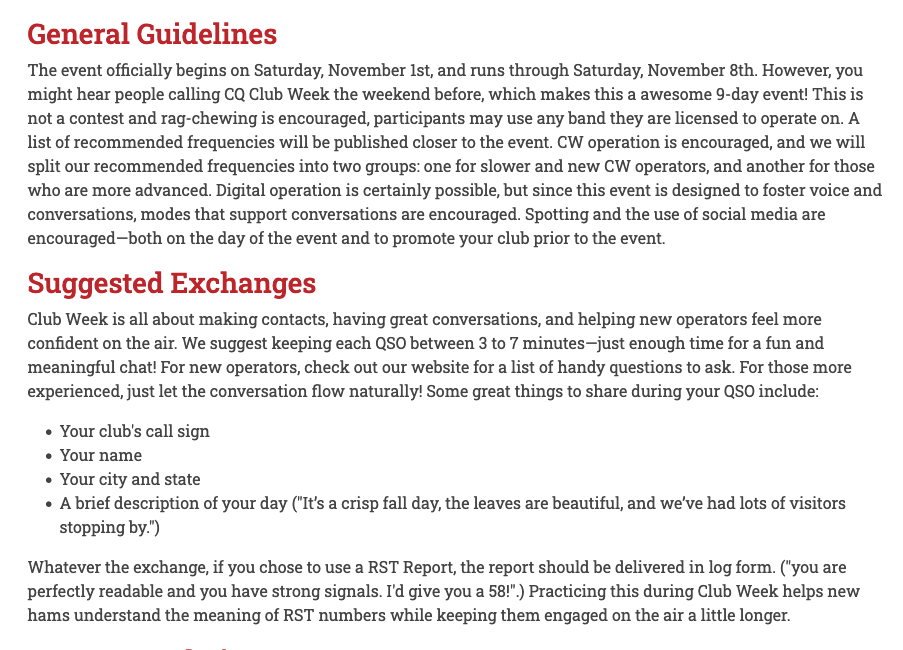
The National Amateur Radio Alliance (NARA) is proud to introduce Club Week. Running November 1–8, 2025, Club Week is all about making contacts, having great conversations, and helping new operators feel more confident on the air.
Club Week is a multipurpose, week-long event. While the primary goal is to contact other clubs and exchange QSL cards, this uniquely designed on-the-air event serves many additional purposes.
Tomorrow is ShakeOut 2025–Amateur Radio Support for USGS! On International ShakeOut Day, October 16, 2025, at 10:16 AM local time, millions of people worldwide will practice earthquake safety. After you “Drop, Cover, and Hold On,” amateur radio operators have a unique role to play: supporting the U.S. Geological Survey (USGS) by submitting Winlink DYFI (“Did You Feel It?”) reports. These reports provide valuable ground-truth data that helps USGS monitor and respond to earthquakes.
By sending your DYFI report via Winlink (cc: SHAKEOUT; ETO-DRILL), you are not only testing our emergency communication readiness but also contributing directly to a critical USGS data stream that informs science, emergency management, and community resilience.
LAXNORTHEAST is once again showcasing the Amateur Radio Community Intensity Map (ARCIM)—a powerful tool that visualizes Winlink DYFI reports (cc: SHAKEOUT) in near real-time. This demonstrates how amateur radio operators can rapidly transform individual reports into actionable, map-based situational awareness.
Prior to World War I and the development and widespread adoption of two-way radio that supported voice, wire telephone spelling alphabets were developed to improve communication on low-quality and long-distance telephone circuits. Bell Systems lead the way.
In June 1915 the world’s first air-to-ground voice transmission took place at Brooklands (England) over about 20miles (ground-to-air was initially by Morse code but it is believed two-way voice communications was achieved by July 1915). In early 1916 the Marconi Company (England) started production of air-to-ground radio transmitters/receivers which were used in the war over France. Military voice radio operators used phonetics unique to their country and often unique to their country and service. (Navy vs Army, etc.)
Throughout World War II, many nations used their own versions of a spelling alphabet. The US adopted the Joint Army/Navy radiotelephony alphabet during 1941 to standardize systems among all branches of its armed forces. The US alphabet became known as Able Baker after the words for A and B.
Modern NATO Phonetics
Eventually the UK came along. Because of contention, US and UK Generals took turns choosing words. 13 each. This was the second “Able Baker” version.
After World War II, with many aircraft and ground personnel from the allied armed forces working in commercial aviation, “Able Baker” was officially adopted for use in international aviation during the 1946 Second Session of ICAO. (International Commission for Air Navigation)
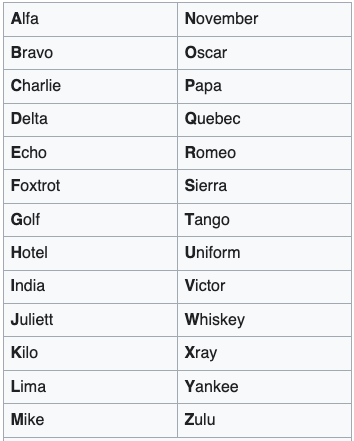
The table we use today, the NATO phonetic alphabet, wasn’t put into service until 1956 — after the Korean War.
For an entertaining recounting of the politics and science (that goes into weeds?) Watch the video. 24 min.
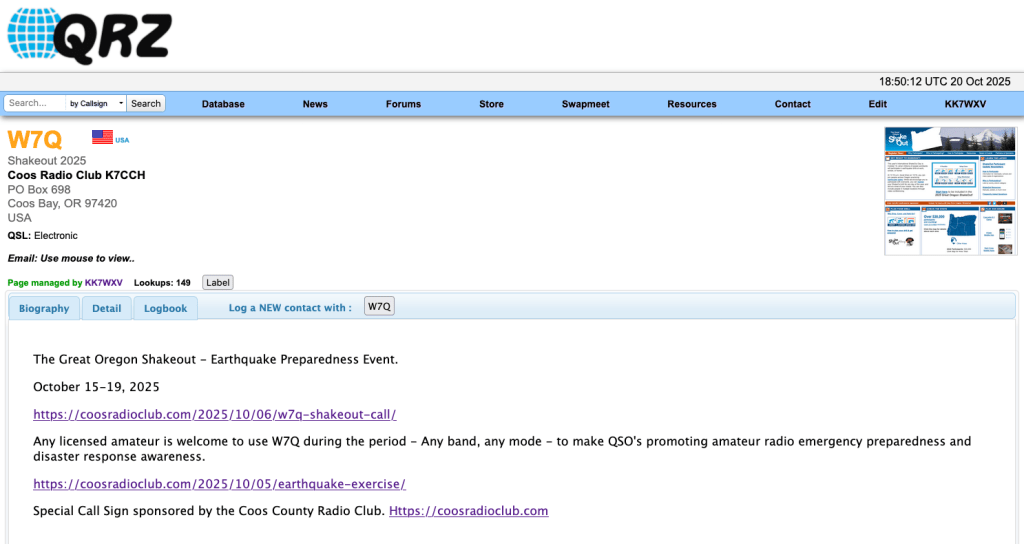
Special Event Call Sign Application for “W7Q” made by CCRC has been approved for use from 2025-10-15 to 2025-10-19.
In conjunction with the Great Shakeout preparedness event on October 16th, the Coos County Radio Club sponsored the special event call sign – W7Q for Earth Quake Preparedness and Awareness.
Licensed Ham Radio operators – especially those in Western Oregon – are welcome to use the call during the period to make QSO’s of any type. But remember! Transmit only within your license privileges.
This is not a contest. QSO cards are up to the operator. Your logs are your logs, but we’d love to hear how you used the event to spread info on Amateur Radio emergency preparedness.
FCC:
When transmitting in conjunction with an event of special significance, an amateur station (“special event station”) may transmit the identification announcement using a special event call sign in accord with the procedures detailed below. Substituting a special event call sign for its assigned call sign may help a special event station call attention “on-air” to its participation in the special event and to the unique opportunity for the amateur service community to exchange greetings with the station. Use of these provisions, however, must not detract from the station making the source of its transmissions known to those receiving them.
The special event station must also transmit its assigned call sign at least once per hour during such operation.


 Coos County Radio Club